Today’s post is from guest author Christopher Sutton, director of Easy Ear Training. Christopher shares terrific insights and advice and I’m thrilled that we all get to learn from him.
Modern Ear Training in Early Music Education
Ear training, the process of developing your ear for music, has always been recognised as an important part of developing good musicianship. Until recently though, ear training was a tedious process which required great determination in the face of dull, repetitive, abstract practice exercises.
This meant that ear training has—understandably—been neglected by most adult learners and almost all young musicians.
As a result they have missed out on all the powerful musical rewards ear training can bring, such as playing by ear, writing music, and improvising freely with an instrument.
Fortunately, modern technology and fresh thinking on how to approach ear training means that it can become a fun, natural and (most importantly) musical activity. By approaching ear training in the right way, students can achieve the kind of “natural musicianship” which inspired them to pick up an instrument in the first place.
Benefits of Early Music Education
The far-reaching range of benefits provided by early music education is fascinating. From literacy and language skills, to physical balance and agility, there is no question that learning music from a young age has a considerable positive impact on children’s lives.
From their earliest days, children’s ears are sensitive to music. In fact, even before they are born you can begin thinking about nourishing a child’s musical ear by choosing suitable sound environments for them to experience.
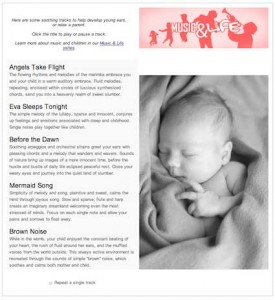
For example, this online “relaxation player” features specially-composed music tracks to soothe and nurture the growing ears of an unborn baby:
Maintaining Musical Motivation
One issue faced by many music teachers and parents is how to keep their young students motivated in the long term. Simply learning pieces, practising scales, and taking instrument exams doesn’t generally hold much interest once that burst of initial enthusiasm wears off.
Particularly once other responsibilities like schoolwork, sport and social life enter the picture, music learning can often be neglected. Less practice time leads to slower progress, which only reduces enthusiasm further.
There is one powerful way to keep the spark of musical joy alive in the long term: developing the core listening skills which give a child true control of their music-making, so that they’re able to creatively express themselves rather than simply playing what they are told to play.
Once a child experiences this empowering musical freedom, their music learning can become addictive—in a good way!
Ear Training Technology
You need only watch a young child interact easily and instinctively with music apps on an iPad (from as early as two years old!) to see the powerful impact technology is having on music education, and how easy it can make it for a child to express themselves musically.
One thing which hasn’t changed: the importance of musical listening skills.
Whether music is created at a piano or with a software app, the young music student today must still rely on their ears to tell them what works and doesn’t. Refining these listening skills through ear training practice can help them to hear more detail, understand what they are hearing, and put that knowledge to practical use in their music-making.

Modern ear training can be made easier for the teacher or homeschooling parent and more enjoyable for the student by taking advantage of modern technology.
Here are a few ideas:
• Watch music learning videos on YouTube which bring music education to life
• Play online ear training games to practice listening skills in a fun way
• Take ear training quizzes and use interactive apps to check progress and provide a rewarding sense of accomplishment
• Download special ear training MP3s which can be used to practice ear training any time, anywhere.
For details, read more about musical resources for early ear training.
Summary
For the young music learner it is developing the core listening skills of music that will bring them real musical freedom and confidence—whether they choose to make music with a violin or an iPad.
Use the latest technologies, and teaching resources like those provided here at EarTrainingandImprov.com, and you can ensure that your young music students not only gain all the musical rewards of ear training—but will also continue to enjoy the journey of music learning throughout their lives.
Christopher Sutton is the director of Easy Ear Training, a music education technology company founded to create new ways to make it it fun and easy to develop your ear for music.
The EasyEarTraining.com website has over 200 articles and tutorials on all aspects of ear training, along with a range of best-selling iOS ear training apps, audio-enhanced eBooks and ear training albums available for download. The ongoing Music & Life web series particularly focuses on ear training in early music education.
Christopher loves learning new instruments and is currently mostly playing bass guitar. He lives in London (UK) with his wife Natalina.
101 Ear Training Tips
Easy Ear Training has a collection of 101 ear training tips in ebook format. Christopher has decided to give all the readers of my blog a special discount–right now you can get the ebook for 20% off! You must use this special discount link to get this deal.
To learn more about the 101 Ear Training Tips ebook click here.